Black Friday for Global Brands: The Seven Trends Shaping the BFCM Peak Season in 2026.

International shoppers in dozens of markets are comparing prices, filling carts, and reviewing products ahead of Black Friday already. Demand builds for weeks, and it peaks in a narrow window where every second counts to capture the peak period of shopper intent and purchasing.
Every weakness in your international ecommerce stack, from an unfamiliar currency to a surprise duty bill or a declined card, gets multiplied by peak volume. A small leak in October becomes a flood in November, and a checkout that holds in a normal week breaks at 4x traffic.
This guide breaks down why Black Friday has become an international peak event, the trends shaping the 2026 season, and the specific challenges cross-border brands face during the surge.
Why Black Friday Is Now an International Peak Season.
Black Friday started as a US retail tradition. It’s now an international commerce event, with shoppers in Europe, the Middle East, Asia, and Latin America expecting deals during the same window. For brands selling across borders, that means one thing: your peak hits every market you sell into, often at the same time. Consumer data from Boston Consulting Group reveals that almost 60% of consumers intend to start looking for deals in October or early November, highlighting that consumers begin their discovery journeys earlier than the BFCM period, and want offers and discounts in advance of the peak period.
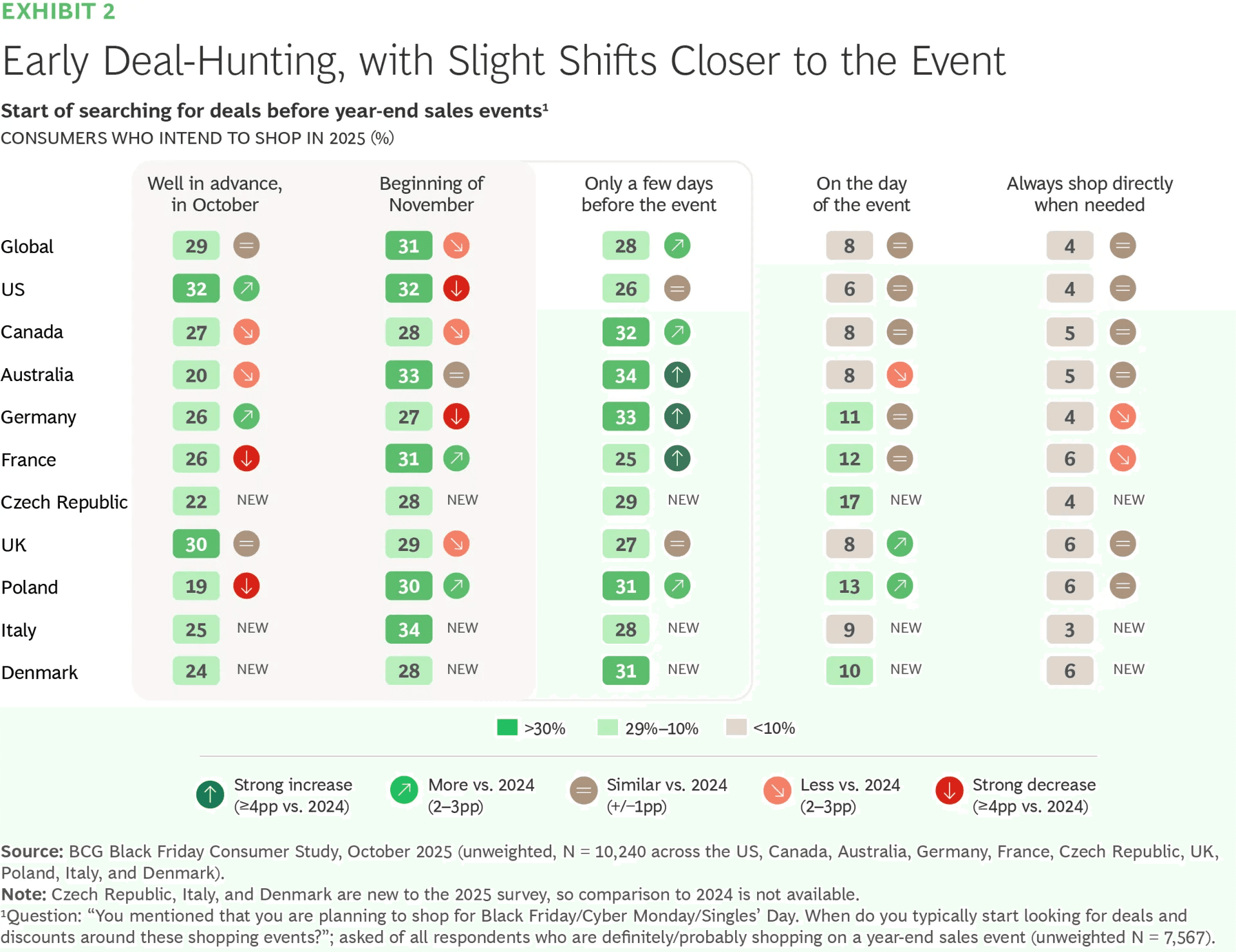
The lesson is clear. Stop planning around a single date. Start planning around a peak season window that opens weeks earlier and closes with the most compressed, high-stakes trading days of your year.
The Seven Trends Shaping the BFCM Peak Season in 2026.
Seven forces define this year’s peak. Each one changes how you prepare, and each one hits harder when you sell internationally.
Holiday Shopping Starts Earlier.
Budget-conscious shoppers are planning purchases sooner and grabbing early deals instead of waiting. Adobe forecasts discounts building steadily through the season: 14% off in early November, 21% off just before Thanksgiving, and 30% off once Cyber Week hits.
For your team, that means inventory, fulfillment capacity, promotions, and customer support need to be ready before the traditional rush. A longer season can be easier to manage than a single spike, but only if your infrastructure holds up for weeks, not days.
Customer Expectations Keep Rising.
Shoppers want value, and they want convenience. They expect clear pricing, fast and predictable delivery, familiar payment options, and easy returns. Shoppers choose free shipping 50% more often than on a normal day, and 67% picked the cheapest shipping option available.
Delivery clarity matters just as much. Shoppers juggling gift deadlines won’t wait to find out if an order will arrive in time. They’ll buy from a brand that tells them.
International Demand Is Driving Growth.
International demand is more accessible than ever. Different countries run different holiday calendars, which opens regional peaks beyond the Western season. International selling also cushions against a soft home market. Instead of betting your whole peak on one country, you spread the opportunity across many.
AI-Driven Traffic Is Surging.
AI is becoming a primary discovery layer for holiday shopping. Adobe found AI-driven traffic to retail sites grew 127% year over year in August 2026. It forecasts that traffic will grow 130% over the holiday season and 141% on Thanksgiving.
That traffic is valuable. Adobe also found 69% of shoppers say they’re less likely to return an item they bought with the help of an AI assistant. If your catalog isn’t readable by AI, you’re not just missing traffic. You’re missing some of your most committed buyers.
BNPL Payments Are Expected To Grow.
BNPL payment giant Klarna documented record Black Friday sales growth in the US, with volume (GMV) up 45% year-over-year for November 2025.
But BNPL is a regional story. ESW Signals 2026 found BNPL adoption ranges from 57% in the Middle East to just 21% in Europe. Surface it where shoppers expect it. Don’t force it where it erodes trust.
Mobile Owns Thanksgiving.
Adobe forecasts Thanksgiving as the strongest mobile shopping day of the season, with $4.4 billion spent on mobile devices, up 11% from 2025. Mobile is expected to capture a 63% share of Thanksgiving online spend. If your international checkout stumbles on a phone or isn’t adapted for mobile-first, you lose the busiest mobile day of the year.
Tariffs and Customs Volatility Rewrite the Rules.
Peak 2026 unfolds against shifting trade policy, evolving customs frameworks, and geopolitical instability. The end of de minimis exemptions that low-cost sellers relied on will shape purchasing decisions for Black Friday in 2026 and returns if Delivered Duty Paid (DDP) is not in place in your ecommerce infrastructure.
These forces change import costs, pricing, and margins quickly. An offer that works today may need a different approach next month. Cost visibility on every order is no longer optional.
Your 20-Item International Peak Season Readiness Checklist.
Run your operation against these 20 checks before peak traffic arrives. Each one closes a gap the Peak Multiplier will find.
- Localize product content for every priority market. Translate product titles, descriptions, sizing guides, and promotional copy, and confirm cultural fit for each market’s holiday campaigns.
- Audit catalog data for accuracy and classification. Verify product attributes, HS codes, country of origin, materials, and dangerous goods flags. Classification gaps trigger customs holds, and at peak volume, every held parcel is a missed gift deadline.
- Make your catalog machine-readable for AI discovery. Structure product data so AI assistants can find, compare, and recommend your products. With AI-driven traffic forecast to grow 141% on Thanksgiving, an invisible catalog forfeits your highest-intent shoppers.
- Localize pricing and promotions by market. Display prices in local currency with market-appropriate rounding and map your promotional calendar to regional peaks beyond Black Friday, from Singles’ Day in Asia to White Friday in the Middle East and El Buen Fin in Mexico.
- Match your payment mix for each market. Lead with the methods shoppers trust locally, whether that’s cards in the US, PayPal in Germany, or wallets in the UK. One standard international template converts nowhere at its best.
- Route payments locally and monitor approval rates. Process transactions through local networks and acquirers, then track approval rates by market daily during peak. Declines that look like noise in October become serious lost revenue in November.
- Surface BNPL where shoppers expect it. Offer BNPL in markets with high adoption, like the Middle East, and keep it secondary where it erodes trust. Treat BNPL as a regional play, not a default.
- Stress-test checkout on mobile and at peak load. Load-test your site, checkout, and shipping rate calls at 4x normal volume, and run every priority market checkout on a mobile phone. Thanksgiving is the biggest mobile day of the season, so your mobile flow carries your peak.
- Show full landed cost at checkout. Calculate duties, taxes, and shipping before the shopper commits, and offer prepaid duties wherever possible. A clear total removes the surprise charges that drive refused parcels and refunds.
- Reprice for tariff and de minimis changes. Review how shifting customs rules and the end of de minimis exemptions affect your import costs and margins in each market. Adjust offers before peak, not mid-campaign.
- Confirm compliance coverage in every market you sell. Verify tax registrations, regulatory obligations, and Merchant of Record coverage across your full market list. If you can’t name who carries the compliance liability on every order, you’re carrying it yourself.
- Calibrate fraud rules for peak volume. Review thresholds and rules ahead of the surge so higher order volume, larger baskets, and new customers don’t trip false flags or slip bad orders through.
- Measure false declines, not just fraud losses. Track how many good customers your fraud rules reject. At peak, a false decline costs you a sale, a customer, and often a competitor’s gain.
- Assign chargeback liability before disputes arrive. Decide who carries fraud and chargeback exposure on international orders, and plan for disputes that land weeks after the season closes.
- Position inventory early and close to demand. Place stock in the regions where peak demand will hit, using last year’s order data and this year’s early-season signals. The wrong location means slower delivery and higher cost on every order.
- Secure carrier capacity and backup options. Lock in peak capacity with your carriers, budget for surcharges, and set up a backup carrier for every major market. A single-carrier setup puts your checkout one outage away from going dark.
- Publish clear delivery promises and gift cutoff dates. Show estimated delivery dates at checkout and publish market-specific holiday cutoffs. Shoppers buy from the brand that tells them their gift will arrive on time.
- Localize your holiday returns policy. Extend return windows for the season, publish clear instructions in each market language, and offer local return options so international shoppers buy with confidence.
- Set up duty drawback recovery. Identify which duties and taxes on returned and re-exported goods you can recover. Without a drawback process, peak returns quietly drain the margin you earned in November.
- Staff customer service and schedule a post-peak review. Scale support capacity in every language and time zone you serve, then book a post-peak review to measure conversion, approval rates, fraud, delivery performance, and returns by market before planning next year.
Black Friday is no longer a single day in a single country. It’s an international peak season that opens in early November, spikes at 4x volume, and flows back as returns well into January. Shoppers expect local checkout, trusted payments, transparent costs, and reliable delivery in every market. This is the season where your revenue matters most.
See how ESW prepares your brand for peak season across every market you sell in. Speak to an ESW expert.